

As part of Transform Finance's Values-Led Business Learning Hub, we've been exploring how governance and corporate structure shape a company's ability to act on its values. Our research for Hiding in Plain Sight found that values-led decisions are already happening across hundreds of companies, but the governance structures behind those decisions remain largely overlooked. This article draws on a conversation with corporate attorney Suz Mac Cormac, who helped draft California's Social Purpose Corporation and Public Benefit Corporation statutes, to lay out what founders should know.
Why Governance Matters and Why Most Founders Don't Think About It Until It's Too Late
Allbirds went public in 2021 as a certified B Corp and Delaware Public Benefit Corporation, with environmental conservation in its charter and dual-class stock giving its co-founders 10x voting power. But after years of declining sales, a Nasdaq delisting warning, and the departure of its co-founder and CEO, the company sold its shoe business for $39 million, rebranded as "NewBird AI," and asked stockholders to vote to strip all environmental commitments from its charter to pursue energy-intensive GPU infrastructure.
Allbirds did more than most companies to build around its values. The question is why those structures didn't hold and what would have made them more durable. Guided by advisors and investors, most founders default to the standard C Corp when incorporating their company. It's only later that they encounter the consequences of that choice: structures that constrain what they can do, or that can't protect the values they actually care about.
Part of why this happens is the operating environment itself. Shareholder primacy, the expectation that corporations exist primarily to maximize returns to shareholders, isn't just a legal doctrine. It's embedded in the incentive structures that surround companies: the standard investment terms required by VCs but also family offices and foundations, the operating principles that founders implement, the way lawyers are trained, the metrics by which boards are judged. Simply put, “success” across the board is measured in dollars and cents.
But there are alternatives and understanding them earlier in the life cycle of a company provides meaningfully more options for founders and others in their orbit. A growing ecosystem of corporate forms, ownership structures, and governance tools now exists specifically to help companies protect their values as they grow. The challenge is that most founders encounter these options too late, after structural decisions have already been made for them by default.
We sat down with Suz Mac Cormac, a corporate attorney who co-chairs the Sustainability + Corporate Responsibility and Social Enterprise + Impact Investing practices at Morrison Foerster. She co-led the drafting group for California's Social Purpose Corporation, an alternative corporate form, and has spent over two decades structuring values-aligned companies from Mozilla to Patagonia, crafting hybrid corporate structures, and advising boards on governance and fiduciary duties. Her perspective added practical depth to the research we've been doing through our Values-Led Business Learning Hub and helped us crystallize the key questions and common pitfalls founders face around governance.
Suz thinks of governance as scaffolding: the legal and structural architecture that determines whether what you're building survives contact with expansion of operations and employee base, investor pressure, and time. A bit of deliberate attention to this scaffolding early on can mitigate significant problems later. The rest of this article lays out what that means in practice.
What It Takes to Build Governance That Lasts
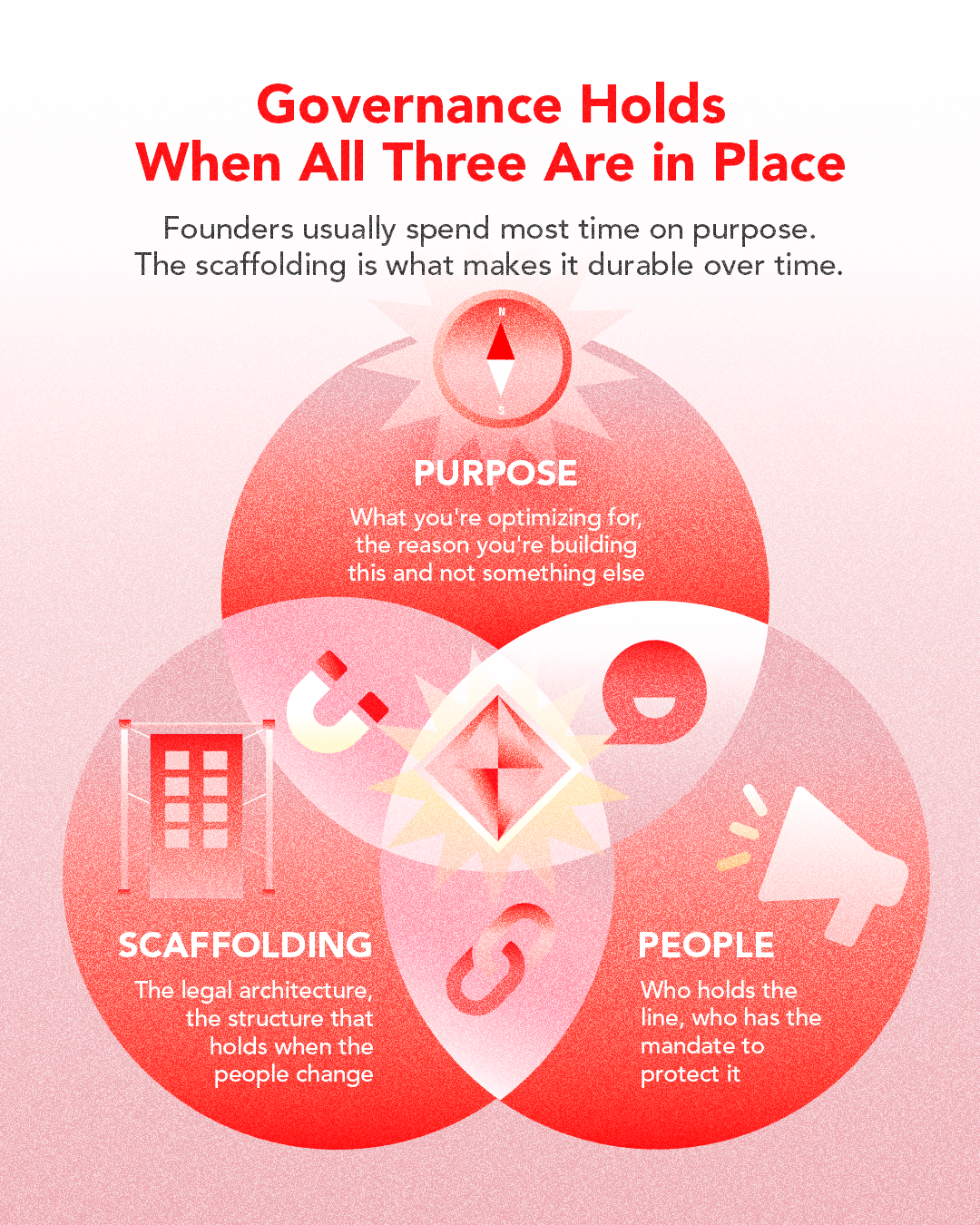
Companies that sustain values-aligned governance over time tend to get three things right: purpose, people, and scaffolding. Treating any one as optional undermines the whole structure.
Purpose. What are you actually trying to accomplish? Who counts as a stakeholder, in what proportion, and over what time horizon? This is the layer founders tend to invest the most attention in. It matters, but on its own it isn't sufficient.
People. Governance structures don't sustain themselves. They need what Suz described as "somebody inside as a champion who really believes it and has enough clout", whether that's a founder, a general counsel, or a board member who will hold the line. Structures that look right on paper routinely fail not because they were drafted wrong, but because no one inside the organization had the mandate or the knowledge to protect them when pressure arose. Yet champions may leave, so these commitments must be institutionalized beyond any single person, which brings us to the following point.
Scaffolding. The legal and structural layer: corporate form, governance documents, ownership arrangements, and enforcement mechanisms. This is the architecture that determines whether values survive a leadership change, an acquisition, or years of investor pressure.
A founding team with a clear purpose but no structural protection may find that purpose eroded as the company grows. Strong legal scaffolding without people who understand and are committed to using it tends to sit dormant on the shelf when it matters most. The companies that get governance right invest in all three from the beginning, rather than backfilling after problems arise.
The rest of this article zooms in the scaffolding. While purpose and people are critical, the structural layer is where the choices are least intuitive and the consequences of getting it wrong tend to surface last. As Suz put it, "a really good lawyer is an engineer", governance is a design problem, and the scaffolding is what you're designing.
Inside the Scaffolding: Rights, Liability, and Enforcement
"People mix these up all the time," Suz told us. Most founders and their advisors treat the scaffolding as a single question; what corporate structure should we use? There are actually three distinct questions that need to be adequately addressed.
Rights and Duties
Rights and duties are defined both by the law and by a company's own governing documents. Together, they establish what a board must, may, and cannot do.
Under standard corporate law, a board of directors has fiduciary duties to the corporation and its shareholders. These include the duty of care (making informed, reasoned decisions), the duty of loyalty (acting in the corporation's interest rather than your own, which includes the obligation to act in good faith), and the duty of obedience (complying with applicable laws and the corporation's own governing documents).
These baseline duties can be shaped significantly by the corporate form a company chooses and what's written into its incorporation documents. A Public Benefit Corporation, for instance, adds explicit duty to an agreed public benefit (in addition to the pecuniary interests of shareholders) and an obligation to consider stakeholder interests. Within a standard C Corp, the way articles of incorporation, bylaws, and shareholder agreements are drafted, what lawyers call "private ordering", can meaningfully expand or constrain what the board is expected to do. The point is that rights and duties aren't fixed, they vary by structure, by jurisdiction, and by the specific choices founders and their lawyers make at incorporation. As Suz noted, "you have to really understand what exists to be able to change it and shape it". Understanding what each form actually requires and what it doesn't protect against is the first step.
Liability
Liability is what actually happens if those duties are breached. And the gap between stated duties and actual consequences is often much wider than founders expect.
The business judgment rule, a foundational doctrine in U.S. corporate law, creates a strong presumption that courts will defer to board decisions made in good faith, on an informed basis, and without conflicts of interest. In practice, this means that a board committed to long-term stakeholder value, an energy transition, or equitable labor practices has real legal latitude to act on those commitments, as long as it does so thoughtfully and documents its reasoning. Shareholder litigation might follow if the stock price drops, but liability for that decision is not automatic. "Corporations could do so much more than they're doing right now," Suz told us, "even without converting to a new form." However, the fear of liability drives much of the decision-making at management and board levels.
On top of that, most corporations indemnify their directors, meaning the company itself covers the legal costs and potential damages a director might face for decisions made in their capacity as a board member. And beyond that, the practical difficulty of actually proving a breach of fiduciary duty in court adds yet another layer of insulation.
This matters in both directions. Companies that could be taking bolder action on their values often don't, because leadership overestimates the legal risk. Meanwhile, founders who assume their governance documents provide strong protection may not realize how hard those protections are to actually enforce, which brings us to the third question.
Enforcement: The Role of the Sentinel
Enforcement is who can actually compel compliance when something goes wrong. The core question is what Suz calls the sentinel: who, specifically, has both the independence and the authority to step in if the company drifts from its commitments? Not today, when the founding team is still in place and motivated, but in ten or fifteen years, when the people and the pressures may look entirely different. Including a sentinel should be explicit in any governance design process: who will enforce this, how, and under what conditions?
For a nonprofit, the sentinel is the IRS and the state attorney general. For a trust structure, it's the trustee, and the quality of that role depends entirely on who holds it, whether they are genuinely independent from the organization they're meant to oversee, and whether they have tools to force compliance. For a conventional corporation, shareholders theoretically have this role.
The following examples illustrate what happens when enforcement is missing:
Allbirds. Allbirds' dual-class stock was designed to concentrate values-protective control with its co-founders, but once the co-founder and CEO departed, that protection left with him. No independent party, no trustee nor outside entity, has the standing to prevent the charter amendment now before stockholders, which would strip the company's environmental commitments. A structure less dependent on any single person, or an independent trustee with authority to block charter amendments, instead of depending solely on the founder, could have created a check that survived leadership changes and financial pressures.
Ben & Jerry's and Unilever. When Unilever acquired Ben & Jerry's in 2000, the deal established an independent board with "primary responsibility" over the brand's social mission. But that board had no independent enforcement mechanism, Unilever as sole shareholder, controls the corporate entity. When Ben & Jerry's independent board tried to exercise its social mission authority, including speaking out on the Israel-Palestine conflict, Unilever blocked the company's public statements and ultimately removed the CEO, allegedly for refusing to silence the social mission. The independent board sued, but Unilever moved to dismiss on the grounds that the board members lacked standing to bring the case at all. "They negotiated for rights with no means of enforcement." The structure was rights-rich and enforcement-poor and the resulting litigation was a foreseeable consequence.
Anthropic. Anthropic structured itself as a Public Benefit Corporation with a "golden share" held by a Perpetual Purpose Trust, a sophisticated arrangement on paper. But the authority to enforce the trust's terms is vested in Anthropic's own board. The board oversees itself. If the board were to drift from its stated purpose over time, there is no independent party with clear standing to intervene. "Circular enforcement is no enforcement."
Meta's Oversight Board. The Oversight Board has no binding authority over Meta's core business decisions. It can publish recommendations and create public pressure, but it has no power to compel the company to act. Public pressure can influence behavior, but it is not an enforcement mechanism, and treating it as one creates a false sense of structural protection.
In each of these cases, the pattern is the same: rights existed, but no one with genuine independence could enforce them.
Licensing as an enforcement tool
One mechanism that remains underused but is practically powerful is the licensing structure. Rather than embedding enforcement inside the corporate entity, which tends to create the circularity risk visible at Anthropic, a founder, nonprofit, or trust retains ownership of a key asset (intellectual property, a trademark, a core technology) and licenses it to the operating company royalty-free, subject to defined mission conditions. If those conditions are violated, the license can be terminated and the company loses access to the asset.
This creates a genuine external check without requiring a new corporate form. It has been used with some success in agricultural and climate contexts and remains almost entirely unexplored in technology, where IP is often a significant leverage point.
Alternatively, there is also the possibility of a “springing” license, if and when a company deviates from its values or is sold to a third party that does not maintain them. In such cases, a “public purpose” license can be automatically granted to a third party (foundation, public charity or other public entity) to use the technology for the values-driven public purpose, usually in a way that does not compete with or negatively impact the valuation of the private company or sale.
For founders who want to preserve optionality around enforcement without committing to a non-standard corporate form from day one, licensing is worth exploring.

What Choices Do Founders Need to Make?
Across this article, Suz outlined a framework of how to think about governance (purpose, people, and scaffolding). Here are the questions she uses to put that framework into practice:
What's the direction? What are you optimizing for, for whom, and over what time horizon and does your current structure reflect that? Do you want to minimize the harm your company’s products or services may cause or to actively maximize the value you may have on stakeholders beyond shareholders?
What's the actual liability picture? If your board makes a decision that advances long-term values but reduces short-term profits, what actually happens given your specific form, jurisdiction, and investor agreements? The business judgment rule provides meaningful protection, and the answer is often more permissive than founders assume.
Who is the sentinel? Who has the genuine independence and authority to hold your company to its commitments, not just today but in fifteen years? Is that person or institution clearly identified, and do they have the standing to act? If the answer is no one, your governance structure has an enforcement gap regardless of how well everything else is drafted.
What tools are you using to enforce? There are multiple ways to build enforcement into a governance structure via licensing, independent trustees, partnerships with public charities and other mechanisms. The right choice depends on context, but the choice needs to be made explicitly.
Allbirds had purpose, and for a time it had people committed to that purpose. What it lacked was scaffolding that could hold when the people and the pressures changed. As Suz put it, the governance failures that have troubled this space have rarely been failures of intention. More often, they're the result of gaps that could have been anticipated and designed around from the start. The earlier founders engage with these questions, the more options they have.

Transform Finance is a research, education, and implementation partner supporting founders, investors, and advisors working toward a more transformative economy. Explore our Values-Led Business Learning Hub for more resources on alternative ownership structures and governance.


